How to Track Migraine: The Complete Guide + Best Apps for 2026
How to track migraine the right way: what to log, the best method, and the top migraine tracker apps for 2026 to help you spot triggers and prevent attacks.
 The Migsy Team 5 min read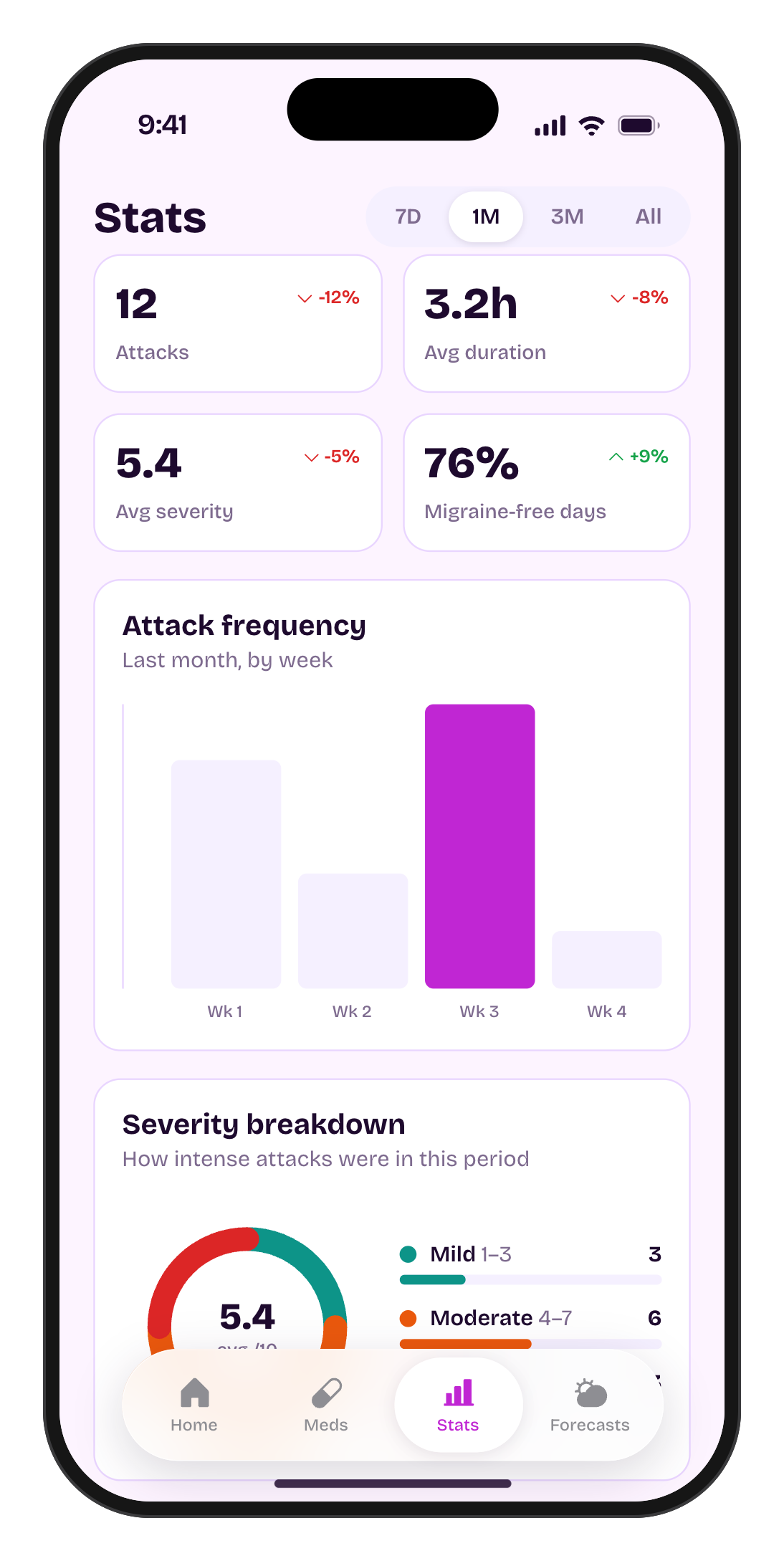
If you live with migraine, you already know the frustration: the attacks feel random. One hits on a quiet Sunday, another ambushes you before a big meeting, and you’re left wondering why now? The truth is that most migraine attacks aren’t random at all. They follow patterns. You just can’t see those patterns from inside the fog.
That’s where migraine tracking comes in. Learning how to track migraine properly is the most practical thing you can do to spot your triggers and get real answers, and the right app makes it almost effortless.
What makes a good migraine tracker
Before the picks, here’s what separates a great migraine tracking app from a forgettable one:
- Fast logging: recording an attack should take a couple of taps, or you won’t keep it up.
- The right fields: severity, duration, pain location, symptoms, medications, and triggers.
- Real insights: it should turn your logs into trends and trigger patterns, not just store them.
- Weather and cycle awareness: two of the most common and overlooked migraine triggers.
- Doctor-ready reports: a clean summary you can share at appointments.
With that bar set, here’s where the top apps land.
The best apps to track migraine in 2026
We looked at what’s available this year against the criteria above. Here’s where things land.
1. Migsy: best overall migraine tracker
Migsy is the app we’d put in most people’s hands first. It nails the thing that matters most (logging an attack is genuinely fast, so you actually keep it up), then quietly does the heavy analytical lifting behind the scenes.
What stands out:
- Two-tap attack logging for severity, duration, pain location, symptoms, and the medications you took.
- Migraine risk prediction that forecasts your high-risk days before they arrive, so you can prepare instead of react.
- A daily risk score on the forecast screen that tells you how likely today and tomorrow are to bring an attack.
- Trigger and pattern insights that turn your history into clear trends instead of a wall of entries.
- A beautiful calendar history where every attack, its intensity, and your treatment is laid out at a glance.
- Doctor-ready reports you can generate in a tap and bring to your next appointment.
- A calm, private, distraction-free design that’s easy to use even mid-attack. Migsy is free to download on iPhone; ongoing tracking is Migsy Pro, billed through Apple.
Migraine prediction is where it pulls ahead
Most trackers only look backward. Migsy also looks forward. It combines two of the strongest predictors of a migraine, a drop in barometric pressure and your own logged attack history, into a forward-looking migraine forecast.
Open the forecast screen and you get a clear risk score for the day ahead, along with why: a pressure drop rolling in, a short night of sleep, a stretch of stressful days. Because the model learns from your own history, the predictions sharpen the more you log, turning a generic weather warning into a personal early-warning system.
That head start is the whole point. Knowing a high-risk day is coming means you can take your preventive medication on time, protect your sleep, skip the trigger foods, and go easier on yourself before the pain starts, rather than piecing together what went wrong afterward.
The combination of frictionless logging, genuine insight, and real prediction is what earns it the top spot. Plenty of apps can store data; Migsy is one of the few that helps you understand it and stay ahead of it. You can download Migsy here. For weather specifically, see barometric pressure and migraine. For clinic visits, see doctor-ready reports.
2. Other options worth knowing
If you want to compare, a couple of other names come up often. Migraine Buddy is a long-established tracker with a large user community and detailed logging, though some features sit behind a subscription. N1-Headache takes a more clinical, data-heavy approach aimed at people who want to run structured trigger experiments. Both are reasonable, but they simply ask for more setup and effort than most people are looking for day to day.
For anyone who just wants to start tracking, see their patterns quickly, and walk into their doctor’s office prepared, Migsy is the easiest place to begin.
How to start tracking today
You can build the habit in five minutes:
- Pick your tool. Download a migraine tracking app so it’s always with you.
- Log your next attack immediately. Don’t wait until you feel better, or you’ll forget the details.
- Add the context. Sleep, stress, food, and how any medication worked.
- Log the small stuff too. Even mild headaches and early warning signs are data.
- Review monthly. After a few weeks, look at your trends and note what keeps showing up.
- Bring it to your doctor. A three-month report is worth more than any verbal summary.
The hardest part is simply starting. Track your very next attack, and let the patterns reveal themselves.
The bottom line
Migraine attacks feel random, but they rarely are. The people who get ahead of their attacks are the ones who write them down: consistently, in the right fields, with a tool that turns those logs into insight. That’s the whole game.
Learning how to track migraine doesn’t require a spreadsheet or a science degree. It takes a couple of taps after each attack and a few weeks of patience. Pick an app that makes logging effortless, start with your next migraine, and give yourself the data to finally answer why now?
Ready to start? Download Migsy on iPhone and log your first attack today. It is free to download; check the in-app paywall for Migsy Pro.
Frequently asked questions
What is the best way to track migraine?
The most reliable way to track migraine is with a dedicated migraine tracking app that logs the date, time, duration, severity, symptoms, medications, and possible triggers for each attack. Apps beat paper diaries because they timestamp entries automatically, surface patterns in charts, and can generate doctor-ready reports.
What should I record in a migraine diary?
For every attack, record the start and end time, pain intensity (0 to 10), where the pain is located, any aura or other symptoms, medications taken and whether they helped, and suspected triggers like sleep, stress, food, hormones, or weather. Consistency matters more than detail: a few tapped fields per attack is enough to reveal patterns over time.
How long should I track my migraine before I see patterns?
Most people start to see meaningful patterns after 4 to 8 weeks of consistent tracking, since triggers like weather, hormones, and sleep often play out over weeks. Tracking for at least two to three months gives you and your doctor enough data to make confident decisions about treatment.
Are migraine tracking apps free?
Many are free to download. Migsy is free to download on iPhone. Ongoing tracking — history, stats, calendar, doctor-ready reports, and weather risk — requires Migsy Pro, billed through Apple. A free trial is offered in the app; always check what a given app puts behind a paywall.
Can tracking migraine actually reduce how often I get attacks?
Tracking itself doesn't cure migraine, but it's one of the most effective first steps toward fewer attacks. By identifying and avoiding your personal triggers, catching early warning signs, and giving your doctor accurate data to fine-tune treatment, consistent tracking often leads to noticeably fewer and less severe attacks.